
Talc Market Size, Growth Drivers, Trends, and Industry Outlook 2026–2034
Talc Market Size
The global talc market is projected to grow from USD 2.25 billion in 2026 to USD 2.93 billion by 2034, exhibiting a CAGR of 3.3% during the forecast period.
Increasing Demand for Plastics Reinforcements and Lightweight Composites Drive Market Growth”
NY, UNITED STATES, February 10, 2026 /EINPresswire.com/ -- The global Talc Market demonstrated significant industrial relevance with a valuation of approximately USD 2.18 billion in 2025, reflecting strong foundational demand from multiple sectors including plastics, ceramics, paints & coatings, pharmaceuticals, and personal care products. Market forecasts project expansion to around USD 2.25 billion in 2026, with further growth expected to position the talc industry at approximately USD 2.93 billion by 2034. This trajectory equates to a compound annual growth rate (CAGR) of about 3.3% during the forecast period of 2026–2034, underscoring steady long-term gains as talc’s industrial applications deepen.— Fortune Business Insights
Get a Free Sample PDF: https://www.fortunebusinessinsights.com/enquiry/request-sample-pdf/talc-market-114815
Market Dynamics and Growth Drivers
Talc, a naturally occurring hydrated magnesium silicate mineral, is prized for its unique physical and chemical properties — notably high thermal stability, lubricity, chemical inertness, and moisture absorption capabilities. These attributes make it indispensable as a functional filler and reinforcement agent in polymers, paints & coatings, ceramics, paper, rubber, and personal care products.
Key Drivers Supporting Market Growth:
Expanding Industrial Base: Rapid industrialization in emerging economies, particularly within Asia Pacific, is propelling demand for talc-filled plastics and composites that enhance mechanical strength and reduce production costs.
Growth in the Plastics Sector: Talc’s reinforcement properties are especially valued in polypropylene and polyethylene resins, where it improves stiffness, impact resistance, and heat tolerance — features critical for automotive and packaging applications.
Rising Paints & Coatings Usage: As construction and infrastructure projects proliferate globally, demand for high-performance paints and coatings that incorporate talc as a rheology modifier and weather-resistant ingredient continues to increase.
Personal Care and Cosmetic Applications: Talc’s ability to absorb moisture and provide a smooth texture has sustained its use in body powders, eye shadows, and other cosmetic formulations, despite growing regulatory scrutiny in some regions.
Automotive Sector Growth: Lightweighting initiatives in automotive manufacturing, especially for interiors, under-the-hood components, and battery casings in electric vehicles, are driving uptake of talc-reinforced polymers that improve durability while reducing weight.
Market Segmentation Analysis
By Deposit Type
The talc market is segmented by deposit type into talc chlorite, talc carbonate, and other talc forms. Talc chlorite remains a dominant category due to its widespread applicability across industrial sectors, particularly in high-grade plastics and coating formulations.
By Form
Talc is primarily commercialised in powdered form, which holds the largest share due to ease of dispersion, consistent product performance, and suitability for a broad array of end uses. Granulated or lump forms are also used in specific industrial processes requiring coarse particulate properties.
By Application
Plastics & Polymers: This segment accounts for significant share due to talc’s reinforcing capabilities and mechanical enhancement of polymer matrices.
Paints & Coatings: Another major application area benefitting from talc’s stability and texture improvement properties.
Ceramics & Rubbers: Talc’s role as a fluxing and filler agent supports its continued integration in these sectors.
By End-User Industry
Key end users include automotive manufacturing, construction and building materials, consumer goods and cosmetics, pharmaceuticals, and paper & packaging sectors. Continuous growth in these industries correlates with increased talc consumption as a multifunctional additive.
Regional Market Performance
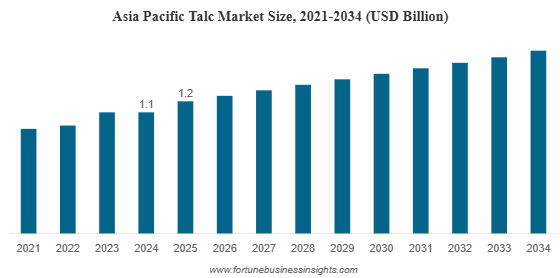
Asia Pacific continues to dominate the global talc market, accounting for the largest share in 2025. This leadership is primarily driven by robust industrialisation in countries like China, India, and Southeast Asian economies, where strong growth in plastics, construction, and automotive manufacturing fuels talc demand.
North America maintains a substantial presence due to established industrial bases and demand from automotive and consumer goods markets, where talc’s performance benefits are extensively leveraged. Furthermore, innovation in talc quality and processing technologies is advancing market expansions in this region.
Europe exhibits sustained growth supported by regulatory frameworks that emphasise product quality, expanded talc use in premium paints and coatings, and automotive sector demand for lightweight components.
Latin America and Middle East & Africa are poised for moderate growth as industrial activities expand and construction projects multiply, particularly in emerging economies within these regions.
Competitive Landscape and Key Players
The talc market is marked by the presence of major regional and global mineral producers and processors. Key companies operating in the space include Imerys, Minerals Technologies Inc., IMI Fabi S.p.A., Golcha Group, Nippon Talc Co., Ltd., and Guangxi Longsheng Huamei Talc Development Co., Ltd. These players compete on the basis of product quality, technological innovation, and global supply chain networks, while also investing in sustainable mining practices to meet evolving environmental and regulatory standards.
To maintain competitive advantage, companies focus on enhancing product purity, expanding processing facilities, and diversifying applications to penetrate newer segments, such as high-performance engineering plastics and specialized ceramic composites.
Market Challenges and Opportunities
Despite its extensive use, the talc market faces several challenges. Regulatory scrutiny, particularly relating to cosmetic applications due to health and safety concerns in certain regions, has prompted product reformulations and greater emphasis on certification and testing protocols. Additionally, availability of substitutes like calcium carbonate and other mineral fillers could modify demand dynamics if pricing or performance advantages shift.
However, significant opportunities remain. Demand for high-performance talc grades tailored to automotive, aerospace, and advanced polymer applications continues to expand. Furthermore, advancements in nanotechnology and surface modification are unlocking new talc functionalities, which can improve dispersion and performance in composite materials, thus broadening its industry footprint.
Outlook and Future Trends
Looking ahead, the global talc market is expected to sustain modest yet stable growth through 2034, underpinned by expanding industrial consumption, evolving automotive applications, and continued talc integration in high-growth sectors such as paints & coatings, pharmaceuticals, and consumer products. Ongoing innovation in mining technology, supply chain optimisation, and product diversification will further reinforce talc’s role as an essential industrial mineral across global value chains.
Press for an Enquiry: https://www.fortunebusinessinsights.com/enquiry/book-a-call/talc-market-114815
Read More Research Reports:
Ceramic Adhesives Market
Ashwin Arora
Fortune Business Insights™ Pvt. Ltd.
+1 833-909-2966
sales@fortunebusinessinsights.com
Legal Disclaimer:
EIN Presswire provides this news content "as is" without warranty of any kind. We do not accept any responsibility or liability for the accuracy, content, images, videos, licenses, completeness, legality, or reliability of the information contained in this article. If you have any complaints or copyright issues related to this article, kindly contact the author above.
